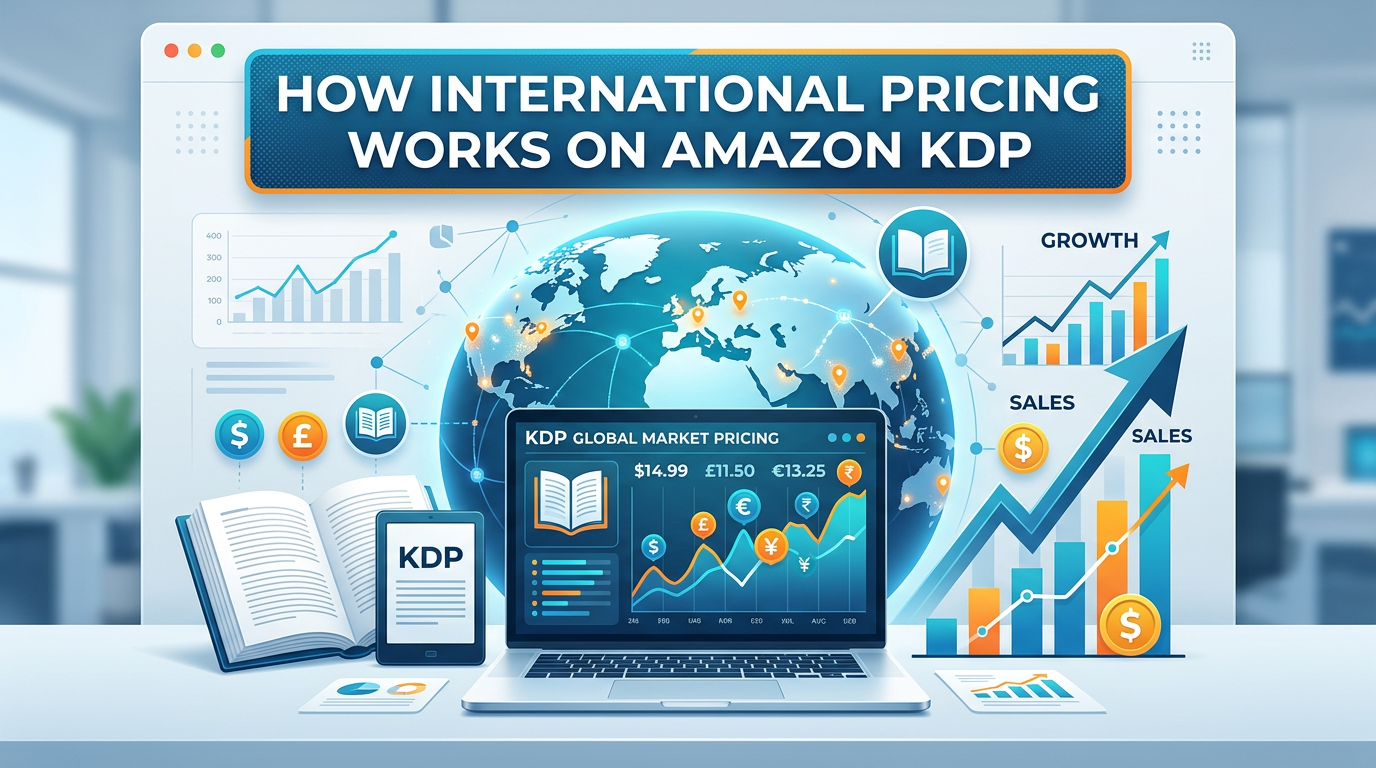
For modern independent authors, the "world is your oyster" is more than just a cliché—it is a business reality. Through Kindle Direct Publishing (KDP), your manuscript isn't just a file on a hard drive; it is a global product accessible in over 190 countries. However, the sheer scale of Amazon’s ecosystem brings a unique set of challenges. How do you price a book for a reader in Berlin versus a reader in Bangalore? How do exchange rates eat into your margins, and why does a $3.99 book suddenly look like a random, unappealing number in British Pounds?
Navigating international pricing is the difference between a hobbyist and a professional publishing business. To maximize your royalty earnings, you must move beyond the "set it and forget it" mentality. This comprehensive guide will break down the mechanics of the KDP global marketplace, explain the nuances of taxes and royalties, and provide actionable strategies to ensure your book is priced competitively across every continent.
The Core Mechanics of Amazon KDP Royalty Tiers
Before diving into international markets, you must master the fundamental royalty structure that governs all KDP transactions. Amazon offers two primary royalty options for eBooks: 35% and 70%. Choosing between them isn't as simple as picking the higher number; each comes with specific constraints that change based on the territory and the file size.
The 70% Royalty Tier: The Professional Standard
To qualify for the 70% royalty rate, your eBook must fall within a specific price bracket—usually between $2.99 and $9.99 in the United States. However, there is a "catch" that many new authors overlook: delivery costs. For every megabyte (MB) of your file size, Amazon charges a delivery fee (typically $0.15 per MB in the US). If you are publishing a high-resolution cookbook or an image-heavy technical manual, these fees can significantly erode your 70% royalty, making the 35% tier more profitable in some niche cases.
The 35% Royalty Tier: Highs and Lows
The 35% tier is mandatory for books priced below $2.99 or above $9.99. The significant advantage here is the lack of delivery fees. If you have a massive file (e.g., 50MB) and you price it at $12.99, the 35% royalty might actually net you more profit than the 70% tier would, as the delivery fees on a 50MB file at the 70% rate would be $7.50, leaving you with pennies. To calculate your exact earnings before hitting "publish," it is highly recommended to use a Royalty Calculator to compare the two options across different price points.
The Global Marketplace: Understanding the 13 Primary Territories
Amazon doesn't just have one website. It operates distinct marketplaces, each with its own currency, consumer behavior, and tax laws. When you set your price in the KDP dashboard, you are often asked to choose a "Primary Marketplace." While most authors choose Amazon.com (US), you must individually check your pricing for the following major territories:
- North America: Amazon.com (US), Amazon.ca (Canada), Amazon.com.mx (Mexico).
- Europe: Amazon.co.uk (UK), Amazon.de (Germany), Amazon.fr (France), Amazon.es (Spain), Amazon.it (Italy), Amazon.nl (Netherlands).
- Asia-Pacific: Amazon.co.jp (Japan), Amazon.com.au (Australia), Amazon.in (India).
- South America: Amazon.com.br (Brazil).
Each of these markets has a different "sweet spot." For instance, the German market (Amazon.de) has a very high demand for thrillers and non-fiction, but readers there are accustomed to slightly higher price points for quality translations. Conversely, the Indian market (Amazon.in) is extremely price-sensitive; a book priced at the equivalent of $4.99 USD might be considered "luxury," whereas ₹99 or ₹149 (roughly $1.20 - $1.80) is the standard for mass-market appeal.
The Impact of VAT and Digital Taxes on International Pricing
One of the most confusing aspects of international selling is Value-Added Tax (VAT) and Goods and Services Tax (GST). In the United States, the price a customer sees on the product page is usually the price they pay before sales tax is added at checkout. However, in the UK and many EU countries, the law requires that the "List Price" shown to the customer must include the tax.
When you set your price for Amazon.co.uk at £2.99, that £2.99 includes a 20% VAT (standard for many digital goods, though some countries have reduced rates for books). This means your royalty is calculated on the net price (the price after tax is removed). If you don't account for this, you may find your European royalties are lower than expected.
Strategic Advice for VAT Compliance
If you want your book to appear as a "clean" price like £2.99 or €3.99, you must manually adjust your list price in the KDP dashboard to account for the local tax rate. Amazon’s auto-conversion tool often results in messy numbers like £3.04 or €3.11, which looks unprofessional to a local reader. Taking five minutes to round these numbers down or up can significantly improve your conversion rates in those regions.
Currency Fluctuations: The Hidden Profit Killer
Amazon allows you to set prices in two ways: by entering a specific price for every currency or by letting Amazon automatically convert your US Dollar price into other currencies. While automatic conversion is convenient, it is rarely optimal.
Exchange rates fluctuate daily. If the US Dollar strengthens against the Euro, your automatically converted price in Germany might rise, potentially pushing your book out of the 70% royalty bracket or making it more expensive than your local competitors. By manually setting your prices, you "lock in" a local price that feels natural to the reader. For example, rather than a converted price of $3.42 CAD, manually setting it to $3.99 CAD creates a much stronger psychological trigger for the buyer.
The Unique Challenges of International Print-on-Demand (POD)
Pricing paperbacks and hardcovers internationally is even more complex than eBooks because of manufacturing costs. Printing costs vary by marketplace. A 300-page black-and-white paperback costs more to print in Australia than it does in the US or Poland.
When setting your print prices, you must consider:
- Minimum Price: This is the base cost of printing plus Amazon’s 40% cut (for standard distribution). If you set your price too low, your royalty will be $0.00.
- Expanded Distribution: If you want your book sold in bookstores and libraries outside of Amazon, your royalty rate drops to 20%, requiring a higher list price to maintain profitability.
- Cover Specifications: Different regions may have slight variations in paper thickness or spine width requirements. Using a Cover Calculator ensures your design fits the physical requirements of the specific printers used in different international hubs.
Advanced Strategy: Market-Specific Pricing and "Price Pulsing"
A "one size fits all" strategy is a missed opportunity. To truly succeed globally, you should employ market-specific pricing. This involves researching the Top 100 bestsellers in your genre on Amazon.co.uk or Amazon.de and seeing where the "cluster" of prices lies.
The "Price Pulsing" Technique
Price pulsing involves temporary price drops in specific regions to coincide with local holidays or promotion cycles. For example, you might drop your price to £0.99 in the UK during a bank holiday weekend while keeping your US price at $4.99. This helps you climb the local category rankings. Once the promotion ends, you return to your standard price, but now with a higher organic ranking and more "social proof" in the form of local reviews.
To maximize this, use the Keyword Combiner to find region-specific search terms. A "cozy mystery" in the US might be searched for as a "whodunnit" in the UK. Combining the right price with the right local keywords is the "secret sauce" of international visibility.
Common Pitfalls in KDP International Pricing
"I set my book to $2.99 globally, but I’m only getting a 35% royalty in Brazil. Why?"
This is a common frustration. To earn 70% royalties in territories like Brazil, Japan, Mexico, and India, your book must be enrolled in KDP Select. If you are not in KDP Select, your royalty defaults to 35% for those specific markets, regardless of your price. This is a strategic lever Amazon uses to encourage exclusivity.
Additional Mistakes to Avoid:
- Ignoring the "Delivery Fee" in 70% Markets: Always check your "Estimated Royalty" column in the KDP dashboard. If the delivery fee is $0.80, you are losing nearly a third of your profit on a $2.99 book.
- Forgetting Local Content: Pricing is just the start. If you price for the Japanese market but your HTML Description Formatter isn't optimized with a description that appeals to Japanese cultural norms, the price won't matter.
- Neglecting the Canada/Australia Opportunity: These markets have high purchasing power and English-speaking audiences. Authors often ignore them, but a simple manual adjustment to $4.99 or $5.99 CAD/AUD can yield high-margin sales.
Expert Insights: The Future of Global Publishing
The landscape of KDP is shifting toward localized AI-assisted translations and regional marketing. Industry trends suggest that Amazon is expanding its printing facilities in the Middle East and Southeast Asia. Authors who establish their "pricing footprint" now will be ahead of the curve as these markets mature.
According to recent industry data, indie authors who manually set their international prices see an average of 15-20% higher conversion rates in non-US territories compared to those who use auto-conversion. This is because "psychological pricing" (ending in .99 or .49) is a universal consumer trigger that auto-conversion destroys.
A Step-by-Step Checklist for Setting Your International Prices
- Identify Your Primary Market: Usually where the majority of your audience lives.
- Calculate Base Costs: Use the Royalty Calculator to find your "break-even" and "target profit" points.
- Manually Adjust the "Big Five": UK (£), EU (€), CA ($), AU ($), and IN (₹).
- Factor in VAT: Ensure your EU/UK prices look attractive (e.g., €3.99, not €3.14).
- Check KDP Select Status: If you want 70% in Japan, India, or Brazil, ensure you are enrolled.
- Optimize Metadata: Use the Keyword Combiner to ensure your keywords match the regional dialects.
- Format Your Description: Use the HTML Description Formatter to ensure your sales copy looks professional on all device types used globally.
Conclusion: The Path to Global Authority
Mastering international pricing on Amazon KDP is not a one-time task; it is an ongoing process of optimization. By moving away from the convenience of automatic conversion and taking control of how your book is perceived in different cultures, you position yourself as a global professional. You aren't just selling a book; you are managing a cross-border retail product.
As you monitor your sales reports, pay close attention to which territories are over-performing. If you see a spike in sales in Australia, consider running a localized ad campaign or adjusting your price to see if you can capture more of that market. The data provided by the KDP dashboard is a goldmine—use it to refine your strategy, maximize your royalties, and bring your stories to readers in every corner of the globe. Success in self-publishing is a marathon, and global pricing is one of the most important stretches of the race. Start optimizing today, and watch your international royalties grow.

Be the first to leave a comment!